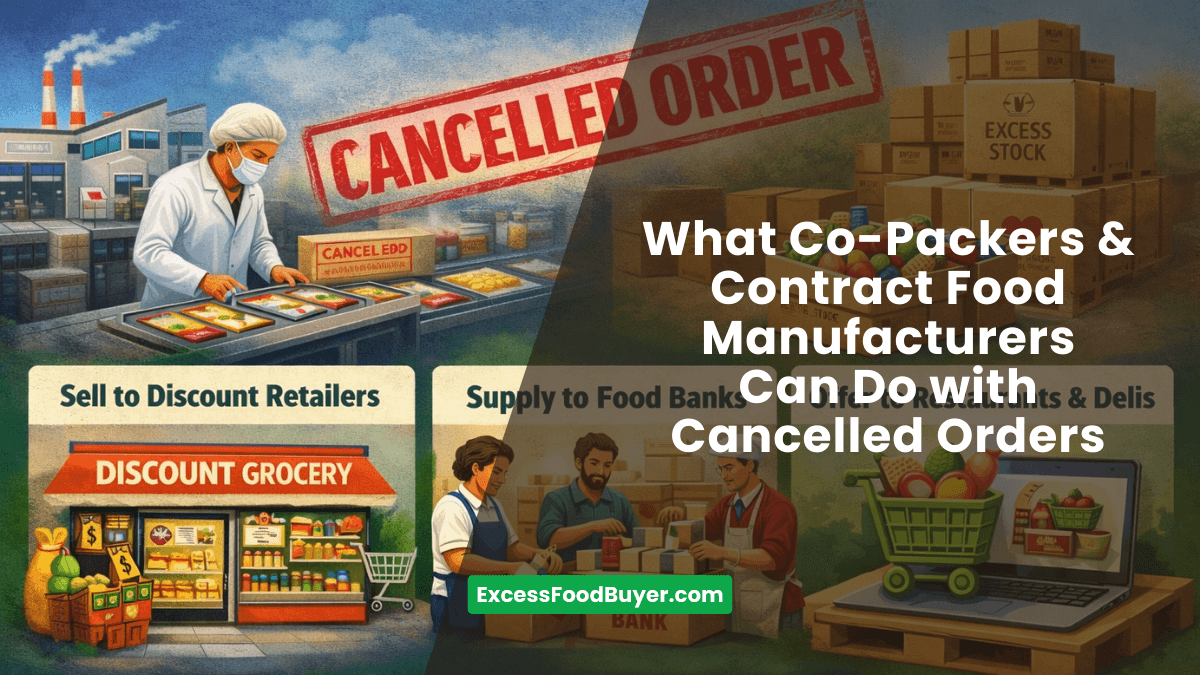
Cancelled orders are an unavoidable part of food manufacturing. For co-packers, contract food manufacturers, and private label food manufacturers, they often arrive with little warning and create pressure across operations, finance, and legal teams all at once.
A brand delays a launch. A retailer backs out. Financing falls through. What was a confirmed production run suddenly becomes finished goods sitting in a warehouse with no clear destination. Shelf life continues to tick down, storage costs rise, and every week that passes reduces flexibility, especially when the inventory is already edging into short-dated food inventory territory.
In food manufacturing, cancelled orders are not just a sales issue. They are a time-sensitive risk event. Mishandling them can create legal exposure, damage customer relationships, or push products into channels where it was never meant to appear. Managing them effectively is dependent on two factors: discretion and an understanding of your rights.
This article describes why cancelled orders are especially difficult for food manufacturers. It looks at the realistic options that are available and how to make these choices to safeguard cash flow, relationships, and reputation.
Why Cancelled Orders Are Especially Challenging in Food Manufacturing
Food manufacturing operates under constraints that don’t exist in many other industries. After the production process is over, time, compliance, and traceability constrain what can be done to the product.
Cancelled food orders commonly include:
- Finished goods tied to expiration or best-by dates
- Customer-specific packaging, branding, or claims
- Ingredients purchased specifically for that production run
- Production capacity already consumed
- Ongoing storage, insurance, and handling costs
For co-packers and private label food manufacturers, cancelled orders become a working capital problem very quickly. Products that cannot be sold ties up cash, space, and resources, all while quietly depreciating in value.
The problem is not merely finding a buyer. The problem is finding a way that does not lead to bigger problems down the road.
Why Food Orders Get Cancelled
Understanding why an order was cancelled can help you determine what options are realistic and which aren’t.
Retail and channel breakdowns are common. A brand may lose shelf space, miss a reset window, or fail to secure distribution. The product exists, but the route to market disappears.
Brand-level cash flow issues are another frequent cause. In these cases, the brand may still want the product but cannot take delivery or pay on agreed terms.
Errors in forecasting are also a big factor. Overproduction based on overly optimistic forecasts, especially for new SKUs, results in cut or cancelled orders once sell-through forecasts are adjusted.
Compliance or labeling changes can render finished goods unsuitable for the original channel, even if the product itself is safe and compliant.
Each scenario leads to the same important question: “Who now controls the inventory, and what are you legally permitted to do with it??”
Step One: Understand Your Rights Before Taking Action
Before selling, reworking, or even marketing cancelled inventory, food manufacturers must clarify their legal and contractual position.
Key questions include:
- Has the title transferred, or does the manufacturer still own the goods?
- Was the order fully paid, partially paid, or unpaid?
- Are there restrictions on resale, diversion, or branding?
- Do confidentiality or non-disclosure provisions apply?
- Is there a formal cancellation process or cure period?
Many co-packers and contract food manufacturers believe that once a customer has canceled, the product is theirs to do with as they please. This is not always the case.
The key is to act quickly. The key is to act with clarity. Clarity comes from knowledge of your rights. Your rights are what enable you to act quickly without creating problems down the road.
Why Discretion Is Essential With Cancelled Food Orders
Cancelled orders often involve branded or retail-specific products, even if the brand no longer wants it. Moving that product carelessly can create problems far beyond the value of the inventory itself.
Common risks include:
- Brand exposure in unintended or sensitive markets
- Channel conflict with existing retailers
- Pricing erosion that damages future negotiations
- Legal claims tied to trademark or diversion issues
For these reasons, discretion is not optional. Experienced co-packers and private label food manufacturers avoid public listings, uncontrolled liquidation, or unknown buyers. Instead, they favor private, controlled placements that respect contractual boundaries and brand sensitivities.
Discretion protects the brand, but it also protects the manufacturer’s reputation in the market.
Option 1: Re-engage the Original Customer First
When an order is cancelled, the initial consideration should be whether the cancellation is actually final. In the food manufacturing industry, many orders are cancelled due to considerations of timing, funding, or retail downstream issues, rather than a lack of faith in the product itself.
Before exploring other options for recovery, it may be worth exploring whether there is a possible course of action that can be taken with the original customer. This is especially true in situations where relationships are an issue, the product has a shelf life that can accommodate flexibility, and there is still a possibility that the original customer may be able to take the product on a new set of terms.
Potential paths include:
- Phased or partial shipments
- Extended or structured payment terms
- Temporary warehousing with an exit strategy
- Minor reformulation or relabeling to facilitate a new SKU
The important thing is to establish a clear timeline. Open-ended waiting periods rarely help the situation. If no progress is made, it is essential to be ready to quickly pursue the next option.
Option 2: Rework or Repackage the Inventory
If the product itself is viable but customer-specific packaging or branding is the primary obstacle, rework may offer a path forward. This option applies when inventory cannot be sold in its current form but could become marketable with reasonable modification.
For co-packers and private label food manufacturers, rework decisions must balance cost, time, and remaining shelf life. In food manufacturing, rework is never just an operational decision. It is a financial one.
Common rework approaches include:
- Removing branded labels
- Applying compliant generic labeling
- Adjusting pack sizes or configurations
- Redirecting product to foodservice or ingredient channels
Rework is only viable when the expected recovery significantly exceeds the additional labor, materials, and production time.
Option 3: Redirect Product to Alternative Food Channels
When the original go-to-market plan is no longer viable, alternative channels may provide an outlet for cancelled inventory. These channels are often more flexible on packaging, pricing, and dating, but they operate very differently from traditional retail.
This option works best when manufacturers act quickly and work with buyers who understand food-specific constraints. Waiting too long can eliminate these channels entirely as shelf life declines.
Alternative channels may include:
- Discount grocery
- Closeout food retailers
- Export markets
- Institutional or foodservice buyers
Each of these channels has its own set of compliance, logistics, and pricing requirements.
Option 4: Work With Excess and Surplus Food Buyers
For many cancelled orders, working with an excess food buyer is the most direct and lowest-risk solution. This option is especially relevant when speed, discretion, and certainty matter more than chasing maximum theoretical recovery.
Specialized excess food buyers exist specifically to handle short-dated, off-cycle, or cancelled production. They understand labeling, compliance, logistics, and contractual sensitivities. Just as importantly, they operate quietly.
Excess food buyers typically:
- Purchase inventory outright
- Accept short-dated food inventory or cancelled production
- Handle logistics and compliance
- Place product through controlled secondary channels
- Prioritize discretion over public resale
For co-packers and contract food manufacturers, this option often converts a complex problem into a clean resolution.
Option 5: Ingredient Recovery or Secondary Use
When finished goods cannot be sold as packaged, ingredient recovery can still preserve some value. This option may be considered when branding, claims, or channels of distribution make resale challenging, but the ingredients are still usable.
Ingredient recovery rarely yields high returns, but it can significantly reduce waste and disposal costs while freeing up storage and production space.
Examples include:
- Selling bulk ingredients to other food manufacturers
- Redirecting products to secondary food uses
- Donation programs where suitable
This option works best when done early before spoilage or compliance issues.
Option 6: Controlled Destruction as a Deliberate Decision
In some cases, cancelled orders cannot be sold, reworked, or repurposed without creating unacceptable risk. While difficult, controlled destruction may be the most responsible and least damaging option.
This decision is typically driven by:
- Legal or contractual exposure
- Brand or customer protection concerns
- Extremely short shelf life
- Storage and insurance costs outweighing recovery
Experienced food manufacturers treat destruction as a risk-management decision, not an operational failure.
The Cost of Waiting Too Long
One of the most damaging responses to cancelled orders is inaction. Every delay increases carrying costs, shrink risk, insurance exposure, and internal distraction. As time passes, options disappear.
Speed is important, but only when combined with clarity and discretion. Food manufacturers that act first will almost always protect more value than those that wait for the perfect response.
Preparing for Cancelled Orders Before They Happen
The best co-packers and private label food companies prepare for cancellations in advance.
The best practices include:
- Title transfer and cancellation clauses in contracts
- Ingredient prepayments or deposits
- Flexible packaging options
- Established relationships with discreet excess food buyers
- Real-time shelf-life tracking
Preparation doesn’t stop cancellations from happening but prevents panic when they do.
Final Thoughts
Cancelled orders are simply a reality of the food manufacturing industry. It is not the occurrence of cancelled orders that distinguishes the best from the rest, but rather the handling of those orders when they happen.
For co-packers, contract food manufacturers, and private label food companies, the key is always to be aware of their rights, to act quietly, to select controlled recovery strategies, and to act quickly without compromising their judgment.
The aim is not to achieve perfect recovery. It is to protect cash flow, to maintain relationships, and to protect reputation.
Cancelled orders, when handled properly, become managed events rather than lingering issues, and allow the company to move ahead with confidence.