A Practical Guide for Food Manufacturers, Distributors, and Retailers
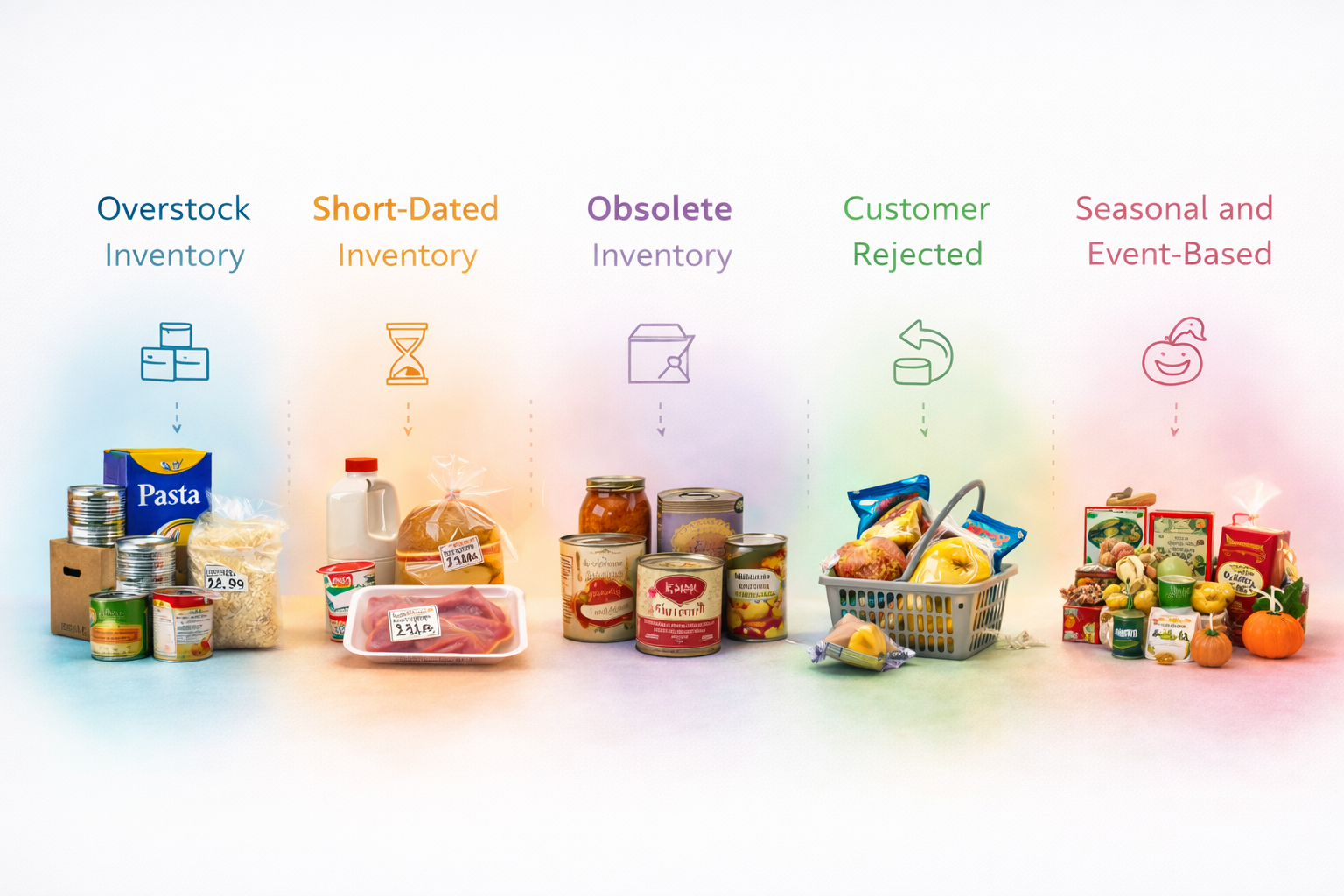
Excess food inventory is not one single problem. It shows up in different forms, for different reasons, and each type carries a different level of urgency and a different set of realistic options.
Many food companies lump everything together as “overstock” and respond to it the same way regardless of what they are actually dealing with. That oversimplification leads to missed recovery opportunities, delayed decisions, and costly confusion. Overstock, short-dated, obsolete, rejected, distressed, and seasonal inventory are not the same thing, and treating them the same costs you money and time you often cannot afford to lose.
This matters because the right response to one type is often the wrong response to another. A company that misclassifies short-dated products as overstock loses the window to act while options are still open. One that treats obsolete inventory like distressed goods moves it carelessly and creates brand problems that outlast the inventory itself. Getting the classification right at the start shapes every decision that follows.
This guide defines each type, explains how date codes affect value, and gives you a simple framework to use the moment a situation arises.
Type 1: Overstock Inventory
Overstock is a product that exceeds current demand but is otherwise fully compliant and within normal shelf-life expectations. The product is good. There is simply more of it than the market will absorb through primary channels right now.
It typically comes from forecasting errors, canceled or reduced customer orders, production minimums that required larger runs than demand warranted, or seasonal miscalculations that left volume behind after the demand window closed.
The key thing about overstock is that you still have time and options. With comfortable shelf life remaining, you can reposition into alternative channels, explore secondary distribution, or evaluate export without racing a deadline. That flexibility is real, but it is not permanent. Every week that passes without action moves you closer to the short-dated window, where options narrow and pricing power erodes. The time to act on overstock is while it still looks like overstock, not after it has quietly aged into something harder to move.
From a value standpoint, overstock retains stronger secondary market pricing than short-dated inventory because buyers have more runway to work with it. A product with ten months of shelf life remaining is a very different proposition than one with three months, even if both technically qualify as overstock. Engage early and the number reflects that.
Type 2: Short-Dated Inventory
Short-dated food inventory is a product that is still safe, compliant, and fully sellable but has limited remaining shelf life. It is not expired. The problem is that traditional retail channels are built around long, predictable dating windows, and once inventory falls outside those windows, mainstream options close off fast.
What qualifies as short-dated is not a fixed number, it depends on the product category. A yogurt with 60 days of total shelf life may be short-dated at 15 days remaining. A shelf-stable snack with 12 months of total shelf life may be short-dated at 90 to 120 days remaining. The measure that matters is not how many days are left in isolation but how that number compares to what buyers and distribution channels actually need to receive, move, and sell the product before it expires.
This is the category where timing does the most damage when companies get it wrong. As remaining shelf life declines, the buyer pool shrinks, retail placements disappear, and pricing compresses to reflect the tighter window. The companies that recover the most value from short-dated inventory are almost always the ones that flagged it early and engaged buyers while they still had leverage. Companies that wait until the window is tight find themselves with a handful of buyers, no pricing power, and a clock running entirely against them.
One thing worth understanding about the value decline: it is not linear. A product with 60 days remaining is not simply worth half of what it was at 120 days. It can be worth considerably less, because of how sharply the buyer pool contracts as dating tightens. Every day without a decision shifts more of the negotiating leverage to the buyer.
Type 3: Obsolete Inventory
Obsolete inventory can no longer move through primary channels because something about the product has changed, not because of shelf life. The food is typically safe, compliant, and far from expiration. It just no longer fits the current go-to-market strategy.
Common examples include old packaging after a rebrand, discontinued SKUs, products tied to expired licensing agreements, label formats that no longer meet updated retailer requirements, and items replaced by reformulated versions.
Brand sensitivity is the defining challenge here. Old packaging or discontinued SKUs showing up widely in the market can undercut current positioning, confuse consumers, and create friction with retail partners who are actively carrying the updated version. Resale restrictions, controlled channel placement, and sometimes export-only or debranding strategies become necessary rather than optional.
It is also a category where companies delay longer than they should, precisely because there is no date ticking down. The urgency is not as visible. But storage costs accumulate quietly, and the secondary market for obsolete inventory softens the longer it sits. Meaningful value is recoverable if you move early. The longer it waits without a plan, the fewer options remain, even when the product itself is in perfect condition.
Type 4: Customer-Rejected Inventory
Customer-rejected inventory is a product a buyer refused to accept even though it is typically safe, compliant, and within normal date expectations. The rejection is usually procedural, not a quality issue.
Common reasons include late delivery past the appointment window, minor pallet damage that did not affect inner packaging, labeling errors, temperature log discrepancies, or spec deviations that fall outside a retailer’s receiving guidelines.
Rejected loads create immediate pressure. Product is usually sitting on a truck or at a third-party warehouse generating cost while the ownership and disposition question gets sorted. Before going to market, two things need to be confirmed: that product integrity is intact and that documentation is complete. Buyers will ask why the load was rejected, and the answer has a real effect on their offer.
When the rejection was procedural and integrity is verified, this inventory can perform similarly to overstock in the secondary market. When documentation is incomplete or cold chain records are missing, pricing compresses quickly and the buyer pool narrows to whoever is willing to absorb that uncertainty.
Type 5: Distressed or Damaged Inventory
Distressed inventory has physical packaging damage but still contains safe, compliant food. The product is intact. The outer packaging is not. Crushed cases, torn shrink wrap, water-damaged cartons, and cosmetic defects to secondary packaging are the most common situations.
The critical distinction is between packaging damage and product damage. A crushed case with intact inner units and legible labels is a workable situation. A case with breached primary packaging is a different conversation entirely. Transparent disclosure upfront is what separates a clean transaction from a disputed one. Buyers who discover undisclosed damage at pickup re-trade offers or walk away. Buyers who knew going in have already priced the situation and move forward.
Damaged packaging reduces price but does not eliminate value. Discount grocery, food banks, export markets, and certain institutional buyers regularly purchase distressed inventory when the inner product is confirmed intact. Clear photos and honest condition disclosure do more work here than in any other category.
Type 6: Seasonal and Event-Based Inventory
Seasonal inventory is a product tied to a specific demand window that has now closed. Holiday-themed packaging, limited-time flavors, event-branded items, and seasonal SKUs that did not fully sell through before demand shifted all fall here. The product is usually safe, within normal shelf life, and fully compliant. The problem is purely timing.
The earlier you decide to exit, the more channels are available and the better the pricing. Most of the time, companies wait too long on seasonal inventory, holding out for a few more weeks of sell-through and end up well past the window with limited options and declining shelf life compounding the problem. Acting before the season closes, or within a few weeks of it, consistently produces better outcomes than waiting for something to change.
Understanding Date Codes: Sell-By, Best-By, and Use-By
Date labeling affects buyer decisions, channel eligibility, and pricing in ways that are easy to misread, and the three main codes are not interchangeable.
Sell-by tells retailers how long to display products on shelf. It is not a safety indicator. Secondary buyers have more flexibility on sell-by dates than primary retail does, but they still need enough runway to move product before it creates problems downstream.
Best-by is a quality indicator, not a safety date. It marks when peak quality may start to decline. Buyers look at remaining best-by days carefully for categories where degradation is noticeable, and shorter windows narrow the buyer pool even when the product is technically still compliant and safe.
Use-by carries the most weight. Most common on perishables, it represents the manufacturer’s recommended last date for both quality and, in many cases, safety. These situations require fast execution and buyers who can move immediately.
The dynamic is the same regardless of which date code applies. As remaining shelf life shrinks, eligible buyers shrink with it, available channels narrow, and the leverage in any pricing conversation shifts away from the seller. A product with 180 days remaining attracts broad interest across multiple channels. The same product at 45 days attracts a fraction of that. At 15 days, you need a buyer who can act today. Waiting to see if a better offer comes in rarely works in a seller’s favor in this category, the value lost while waiting almost always exceeds whatever the hold-out was trying to gain.
A Simple Internal Classification Framework
When excess inventory surfaces, answer these five questions before doing anything else:
- How many days of shelf life remain, and how does that compare to what standard channels require?
- Is the product fully compliant and released for sale?
- Is there brand sensitivity around where this product ends up?
- Is the packaging current, outdated, or damaged?
- Is the product ambient, refrigerated, or frozen?
The answers will tell you which category you are dealing with, which channels are realistic, and how fast you need to move. A frozen product with outdated packaging and 45 days remaining is a completely different situation than an ambient overstock with 10 months of shelf life and no brand concerns. Both are excess inventory. The path forward for each looks nothing alike.
The companies that consistently recover the most value are the ones who run through these questions when inventory is first flagged, not three weeks later when the situation has already deteriorated.
Where ExcessFoodBuyer.com Fits
Not every buyer can handle every type of excess food inventory. Cold chain products require different logistics than ambient. Brand-sensitive placements require controls that most buyers do not think about. Short-dated inventory requires a buyer who can move within days, not weeks.
ExcessFoodBuyer.com work across all of these categories. Short-dated inventory, customer rejections, temperature-sensitive products, obsolete inventory requiring controlled placement, and distressed packaging where the inner product is confirmed intact. We respond within hours, purchase outright, handle refrigerated and frozen logistics, and place products through discount retail, food banks, and export channels in a way that keeps it away from your core markets. We have purchased inventory with as little as 14 days of remaining shelf life.
If you know what you have and are ready to explore what recovery looks like, send us your product details. We will have an offer back within 24 hours.
Final Thoughts
Food companies that understand the differences between these inventory types make faster decisions and recover more value. Not because they have better inventory, but because they know what they are dealing with early enough to do something about it. Classification is not an administrative step. In food, it is the decision that determines whether you have options or not.